


Deepseek has silently released a bombshell update to the Deepseek v3 base model. And surprisingly, it went under the carpet amid the Chatgpt image generation launch. It has improved over its predecessor in reasoning and coding. The current coding champion (in raw output) is Claude 3.7 Sonnet.
I was intrigued by how much of an improvement Deepseek v3 0324 is over the original one. It matched GPT-4o, and from the benchmarks, it is on par with the Sonnets.
So, let's get started.
Deepseek V3-0324 Details
Here are some key details worth noting about the new v3 checkpoint:
🧠 685B MoE parameters
🚀 641 GB of total size in full-precision
💻 Better code-generation abilities
🛠️ Smarter tool-use capabilities
🏃♂️➡️Improved reasoning, thanks to RL training with GRPO
🧩 Open Sources under MIT License
Deepseek v3 0324 scores higher on benchmarks
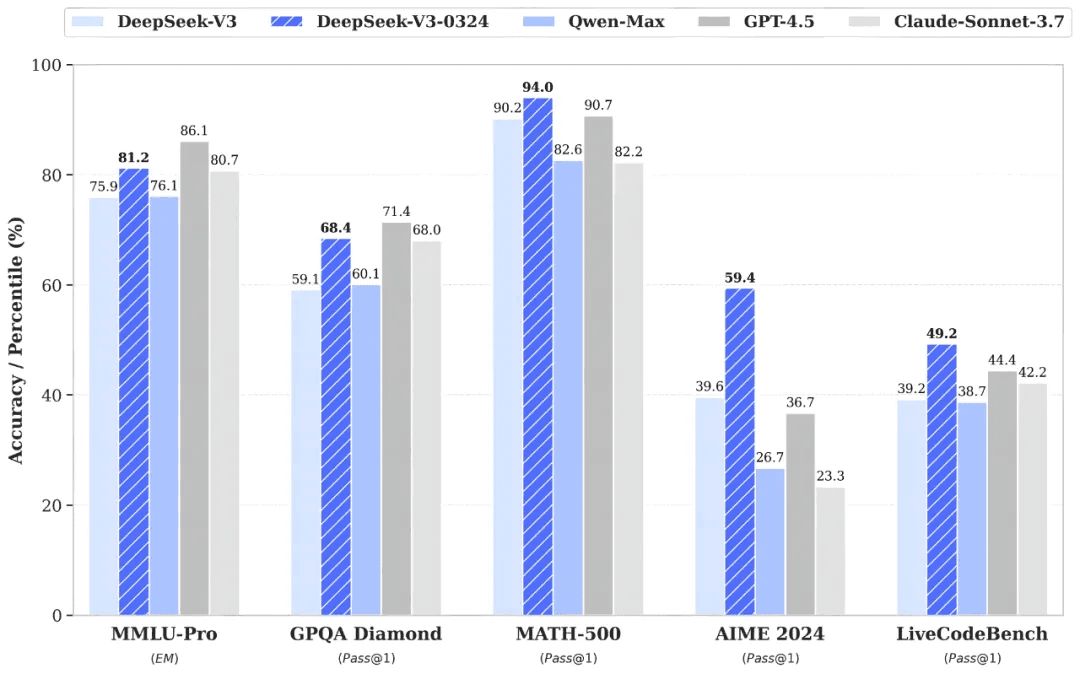
credits: Deepseek official docs
To Learn More:
Having known the specifications, let’s now evaluate the model's performance.
Evaluating Coding Performance
As we will compare the model against Claude 3.7 Base, which is a beast in terms of coding, let’s compare Deepseek V3 performance against the same benchmarks for a level comparison.
For the evaluation test, I will select 4 to 5 examples from my curated set and assess the performance of both models on the given task. Additionally, points will be given to winners. In case of a tie, each contender receives 1 point.
We will compare the output based on code length, quality and response quality.
So, let’s start!
Test 1: 3js simulation
Prompt: Create a 3JS simulation of a metropolitan cityscape.
This test shows how good a model is at 3JS and their internal creativity. This is a zero-shot test, so all the simulation code was generated in one go. Here are the responses from the respective models.
Deepseek v3 0324:
The generated cityscape is clean, and the buildings, roads, and even traffic are defined. Although the movements weren't working, the traffic toggle was functioning correctly.
Claude 3.7 Sonnet:
The buildings and roads are less detailed than Deepseeks's, but the movement worked; it was a first-person perspective simulation.
Deepseek was better overall regarding artefacts and animation, but fixing the navigation would have taken another prompt. Deepseek v3 0324 won this round, so Deepseek gets one point.
Off to test No. 2
Test 2: LeetCode - Problem #2861 Solution
For the next test, I will use a tricky question for the Leet Code: “Power of heroes.” Most of the LLMs tested earlier solved this problem with reasonable accuracy. Let’s see if Deep Seek V3 and Claude Sonnet 3.7 keep up the pace.
Prompt
You are given a 0-indexed integer array nums representing the strength of some heroes. The power of a group of heroes is defined as follows:

Let i0, i1, ... ,ik be the indices of the heroes in a group. Then, the power of this group is max(nums[i0], nums[i1], ... ,nums[ik])2 * min(nums[i0], nums[i1], ... ,nums[ik]). Return the sum of the power of all non-empty groups of heroes possible. Since the sum could be huge, return it modulo 109 + 7.

Example 1:

Input: nums = [2,1,4] Output: 141 Explanation: 1st group: [2] has power = 22 * 2 = 8. 2nd group: [1] has power = 12 * 1 = 1. 3rd group: [4] has power = 42 * 4 = 64. 4th group: [2,1] has power = 22 * 1 = 4. 5th group: [2,4] has power = 42 * 2 = 32. 6th group: [1,4] has power = 42 * 1 = 16. 7th group: [2,1,4] has power = 42 * 1 = 16. All groups' powers are 8 + 1 + 64 + 4 + 32 + 16 + 16 = 141.

Example 2:

Input: nums = [1,1,1] Output: 7 Explanation: A total of 7 groups are possible, and the power of each group will be 1. Therefore, the sum of the powers of all groups is 7.

Constraints:

1 <= nums.length <= 105 1 <= nums[i] <= 109

Optimize the code for time and space complexity and write clearly, concisely and cleanly. Avoid code redundancy
If both models might solve the challenge, the evaluation will be based on Time, Space complexity, and response output time.
Let’s check the outputs.
Output: Deep Seek V3 (Code -67.7s )
class Solution:
    def sumOfPower(self, nums):
        MOD = 10**9 + 7
        nums.sort()
        n = len(nums)
        power_of_two = [1] * n

        for i in range(1, n):
            power_of_two[i] = (power_of_two[i - 1] * 2) % MOD

        res = 0
        sum_prev = 0  # This will accumulate the sum of nums[j] * 2^j terms for j < i

        for i in range(n):
            # The current element can be the max in subsets where it is included, and any subset of previous elements.
            # The min in such subsets can be any of the previous elements or itself.
            # The contribution when nums[i] is the max: nums[i]^2 * min_of_subset
            # The sum over all such subsets is nums[i]^2 * (sum_{S includes nums[i] as max} min(S))
            # The sum of min(S) for all S where nums[i] is max and S includes nums[i] and any subset of elements before i:
            # For each j <= i, the min is nums[j] and the count is 2^{i-j} if j < i, or 1 if j == i.
            # So sum_{j=0 to i} nums[j] * 2^{i-j} when j < i, plus nums[i] * 1 (when j=i)
            # This can be rewritten as (sum_{j=0}^{i-1} nums[j] * 2^{i-j}) + nums[i]
            # But this is similar to the previous terms multiplied by 2 each step plus nums[i]
            # So we can maintain this sum dynamically.

            # The term for nums[i] being the max in subsets:
            # The sum of min(S) for all subsets S where max(S) = nums[i] is (sum_prev + nums[i])
            # Because sum_prev is sum_{j < i} nums[j] * 2^{i-j-1}, but we can compute it incrementally.
            current_contribution = (sum_prev + nums[i]) % MOD
            term = (nums[i] * nums[i]) % MOD
            term = (term * current_contribution) % MOD
            res = (res + term) % MOD

            # Update sum_prev for next iteration: sum_prev * 2 + nums[i]
            sum_prev = (sum_prev * 2 + nums[i]) % MOD

        return res
Results
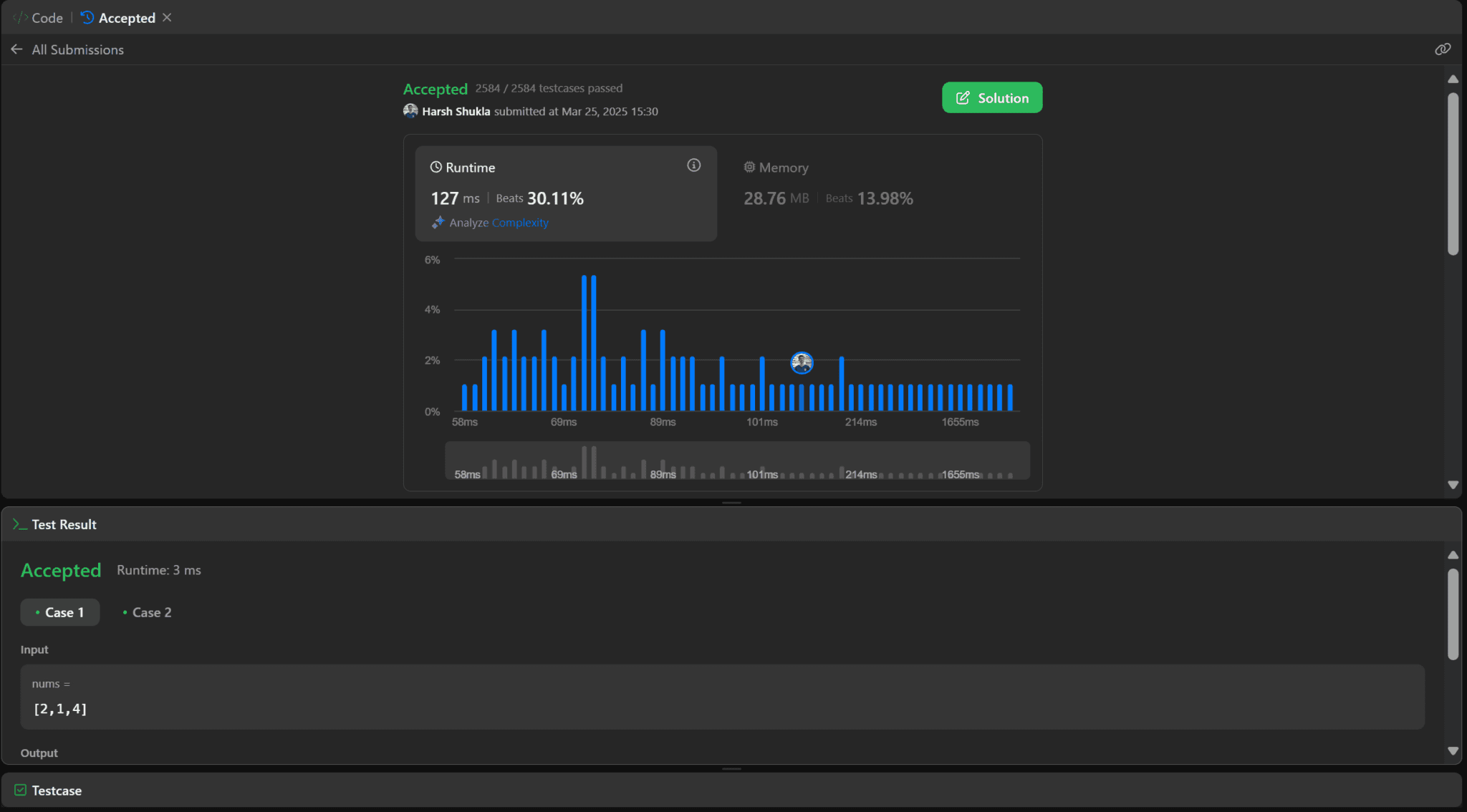
Deep Seek V3 solved the code and handled the Time & Space Complexity as instructed.
As for code quality, it is long, well-explained, documented, straightforward and easy to follow.
Now, let’s see how Sonnet 3.7 Performs!
Output: Claude Sonnet 3.7 Base (Code - 16.5s)
class Solution:
    def sumOfPower(self, nums):
        MOD = 10**9 + 7
        nums.sort()
        result = 0

        # Process each potential max value
        for i in range(len(nums)):
            # For single element group
            result = (result + nums[i]**3) % MOD

            # For groups with more than one element
            # Count contribution of this element as max with all possible mins
            for j in range(i):
                # This is the count of subsets where nums[j] is min and nums[i] is max
                # We need to multiply by 2^(i-j-1) to account for all possible subset combinations
                # between j and i (excluding j and i)
                contribution = (nums[i]**2 * nums[j] * pow(2, i-j-1, MOD)) % MOD
                result = (result + contribution) % MOD

        return result
Results:
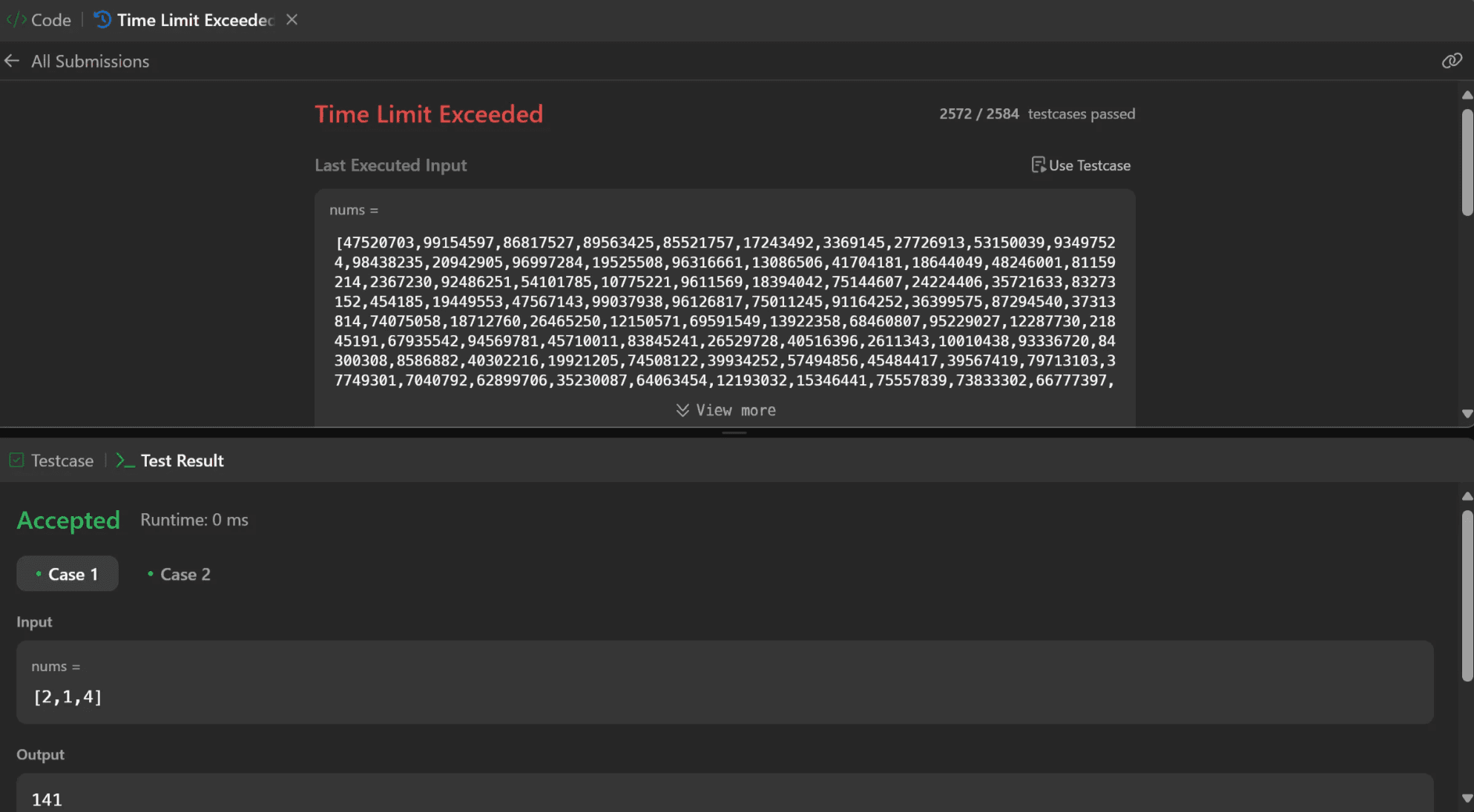
The model-generated code passed the public test cases but failed to handle Time Complexity.
The code quality is good, well explained, documented, clear, concise, and easy to follow.
Final Thoughts
Deep Seek V3 code was long and explanatory with high response time, but passed the test cases and handled the time and space complexity.
Sonnet on the other hand responded with shorter cleaner code with low response time but failed to pass the private test cases.
If I prepare for Coding Exams & Interviews, I will go for Deep Seek V3 for code references.
Current Score: Deep Seek v3 - 2, Claude Sonnet 3.7 - 1
off to test no 3
Test 3: Leet Code - Problem #3463 Solution
I found this one while writing my other blog, and it became my benchmark question for evaluating LLM's coding capabilities.
This requires first-principle thinking rather than library usage. Let’s see how Deep Seek V3 and Sonnet 3.7 Base perform.
I am personally excited about Deep Seek V3's performance because last time, only Grok3 (Think Mode) was able to solve it!
Prompt
I am giving you a leetcode problem with test case, your job is to write a clean and concise code.
The question will have private test cases, so make sure your cover edge cases as well.
You can solve this qn using 1st principle reasoning
Here is the problem Statement :

You are given a string s consisting of digits. Perform the following operation repeatedly until the string has exactly two digits:

For each pair of consecutive digits in s, starting from the first digit, calculate a new digit as the sum of the two digits modulo 10.
Replace s with the sequence of newly calculated digits, maintaining the order in which they are computed.
Return true if the final two digits in s are the same; otherwise, return false.

Example 1:

Input: s = "3902"

Output: true

Explanation:

Initially, s = "3902"
First operation:
(s[0] + s[1]) % 10 = (3 + 9) % 10 = 2
(s[1] + s[2]) % 10 = (9 + 0) % 10 = 9
(s[2] + s[3]) % 10 = (0 + 2) % 10 = 2
s becomes "292"
Second operation:
(s[0] + s[1]) % 10 = (2 + 9) % 10 = 1
(s[1] + s[2]) % 10 = (9 + 2) % 10 = 1
s becomes "11"
Since the digits in "11" are the same, the output is true.
Example 2:

Input: s = "34789"

Output: false

Explanation:

Initially, s = "34789".
After the first operation, s = "7157".
After the second operation, s = "862".
After the third operation, s = "48".
Since '4' != '8', the output is false.
If you look carefully, we have explicitly mentioned that the code needs to be solved using the first principle and must be clear, concise, explanatory, and cover all edge cases.
Though we never mentioned it's a question about Pascal's Triangle, figuring it out is part of the model reasoning process.
Let’s see which one can identify and solve it.
Output: Deep Seek V3
def isSameAfterOperations(s: str) -> bool:
    while len(s) > 2:
        new_s = []
        for i in range(len(s) - 1):
            new_digit = (int(s[i]) + int(s[i+1])) % 10
            new_s.append(str(new_digit))
        s = ''.join(new_s)
    return s[0] == s[1]
Result
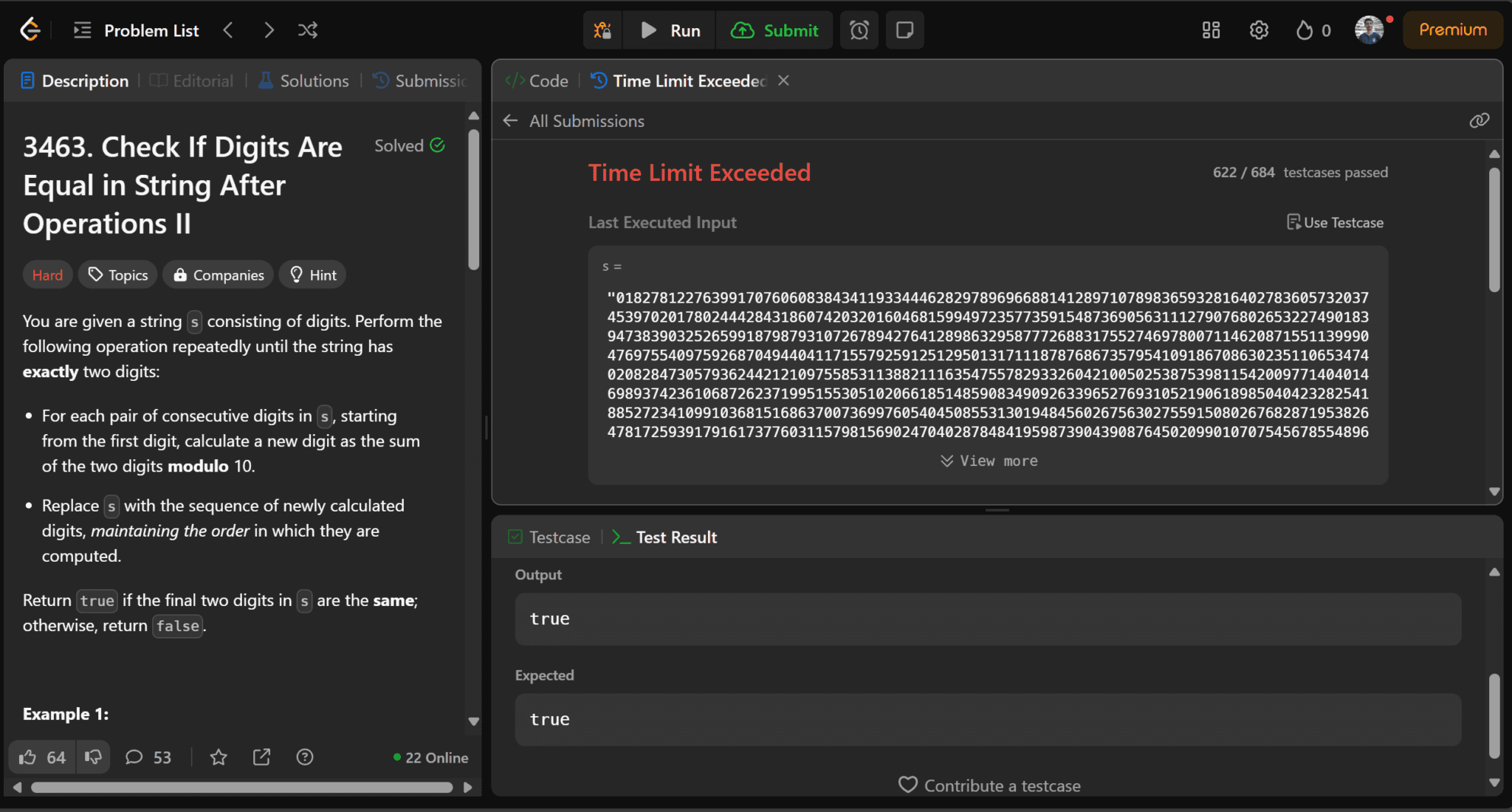
Time Limit Exceeded - Sonnet 3.7 Base
Yup, it’s also failed. So Grok3 still keeps its spot!
Though I liked the concise code, I hated the lack of clear comments and the model's failure to follow the first principal reasoning abilities.
Let’s see how Claude Sonnet 3.7 Performs
Output: Claude Sonnet 3.7
def isSameSequence(s: str) -> bool:
    # Continue until we have only two digits
    while len(s) > 2:
        new_s = ""
        # Process each consecutive pair
        for i in range(len(s) - 1):
            digit1 = int(s[i])
            digit2 = int(s[i+1])
            new_digit = (digit1 + digit2) % 10
            new_s += str(new_digit)
        s = new_s

    # Check if the two remaining digits are the same
    return s[0] == s[1]
As usual, the sonnet verified its steps, which helped it pass the public test cases, but was not enough to pass the private test case, resulting in a Time Limit Exceed Error.
Time Limit Exceeded - Sonnet 3.7 Base
Though Sonnet also failed, the code was well documented, short and clear. Would go for it!
Final Thoughts
Deep Seek V3 code was short and concise, but the code was not clear (as there were no comments) & model failed to follow the instructions given in the prompt.
On the other hand, Sonnet responded with a more extended code, but it was concise and clear and followed the instructions except for the first principal reasoning through the process to follow.
Current Score: Deep Seek v3 -2, Claude Sonnet 3.7 - 0
Off to test No 4
Test 4: Minecraft Game in Python (One Shot Prompting)
Till now, we have explored 3D Scene Generation and Coding problems; what about building a complete solution.?
So, can Deepseek V3 / Claude Sonnet 3.7 build a full-stack application that handles all the intricacies? Let’s check it out.
For this, let’s build a Minecraft game using Python using One-Shot Prompting
💡Disclaimer: The prompts are taken from Build the full stack application using GPT prompts (article by @rsharma5)
Prompt
Please help me build a straightforward Minecraft game using PyGame in Python.
Output: Deepseek V3
Code: GitHub (deepseek_v3_results.py) + instructions with install instructions.
How to Play:

Left-click to place the selected block

Right-click to remove a block

Click on the inventory at the top to select different block types (grass, dirt, stone)

Features:

Simple world generation with grass, dirt, and stone layers

Basic block placement and removal mechanics

Inventory system to select different block types

Grid-based placement system

Requirements

Python 3.x

Pygame library ( pip install pygame)
Results

Deepseek Results
As expected, Deepseek V3 wrote the right code on the first try—impressive. It even cloned Minecraft's building mechanics!
The block palette selection UI isn’t working, and there’s still room for improvement. But overall, I am impressed by the output.
Output: Claude Sonnet 3.7 Base
Code: GitHub (claude_sonnet_3.7_results.py) + instructions with movement details but no install instructions.
How to Play

1. Movement:

A/Left Arrow: Move left

D/Right Arrow: Move right

Space: Jump

2. Interact with Blocks:

Left-click: Break a block (adds to inventory)

Right-click: Place a block (uses from inventory)

3. Select Blocks:

Press 1-6 to select different block types from your inventory

Game Features

Simple terrain generation with grass, dirt, and stone

Random tree generation with wood and leaves

Basic physics with gravity and collision detection

Simple inventory system

Camera that follows the player </aside>
Results
I never expected this, but the program crashed. Based on the output, it is a Type error.
After explicit prompting, here are the results(claude_sonnet_3.7_game_results.py):
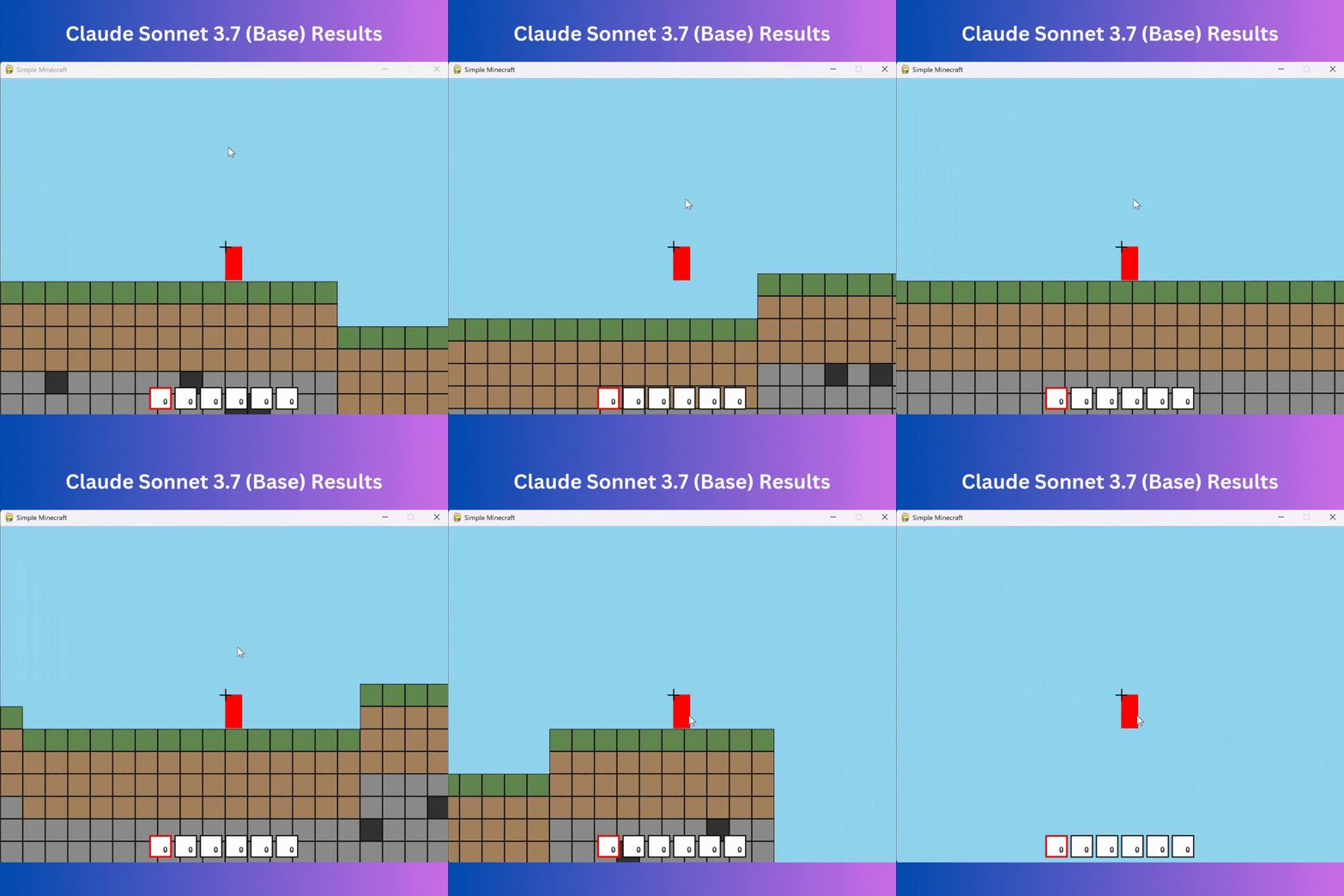
I expected the model to build a Minecraft with functionality to add blocks and movement, but it made something totally different—a 2D Platformer.
There is no way to delete or add blocks; it resembles a 2D platformer with a wobble effect (not what was needed), and there is no button value change in the UI (similar to DeepSeek v3).
Overall, here are my final thoughts on this test.
Final Thoughts
Deep Seek V3 mimicked some parts of Minecraft (adding, deleting, and selecting blocks), followed physics, wrote good code, and ran on the first try.
On the other hand, Sonnet 3.7 Base struggled—it needed multiple prompts, failed physics rules, and had a wobbling effect. While it eventually produced working code, it lacked the expected functionality (adding, removing and selecting blocks).
Do note that both models have the potential to implement different functionalities with the same prompt, but DeepSeek V3 code and output were more polished in terms of One-Shot Prompting.
So, 1 point goes to Deep Seek V3
Current Score: Deep Seek v3 -3, Claude Sonnet 3.7 - 1
Who Aces the Test?
After evaluating model responses over multiple tests:
Claude Sonnet 3.7 Base Score: 1/4
Deepseek V3 Score: 3/4
Winner: Deepseek V3 0324
Final Thoughts
Deep Seek V3 excelled in the simulation, game building, and LeetCode problems (medium difficulty). It scored 3/4, while Sonnet only passed 1/4. It's a very vibe-based test, but it paints a good picture of how capable the new Deepseek v3 0324 is.
The open-source base models have almost closed the gap with the proprietary models. Deepseek v3 0324 is among the top base models of major AI labs and even surpasses many others. It is not even a generation jump but a new checkpoint of the same model that was considered average 3 months back. Nobody will be surprised when Deepseek finally releases a state-of-the-art model this year.

 Get started